







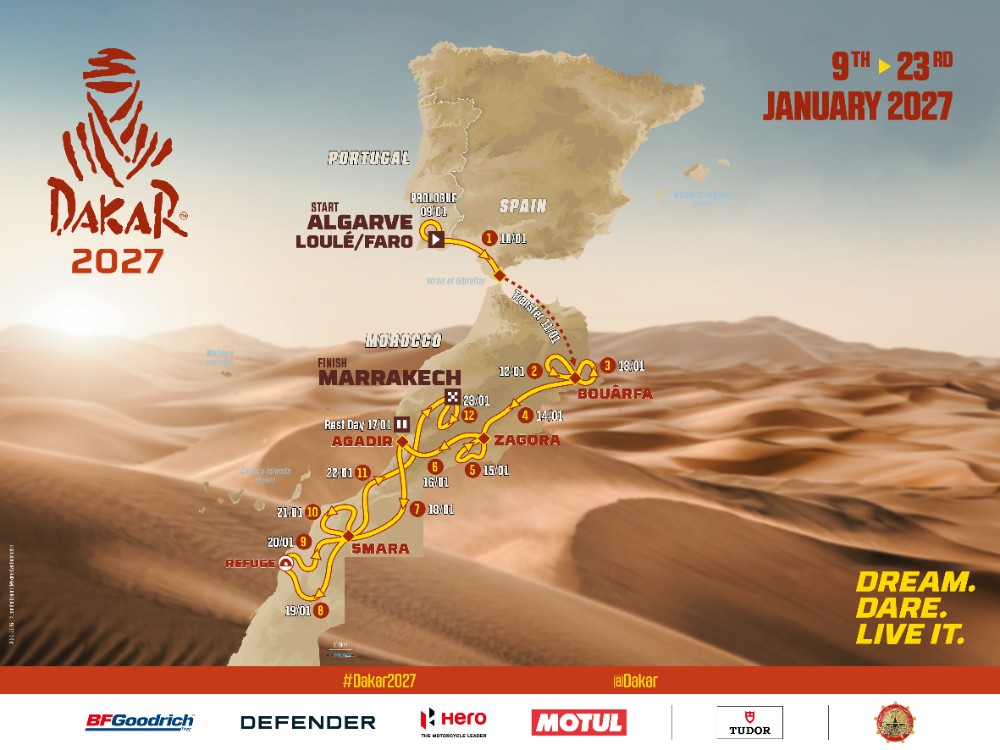
Faced with a difficult situation that has led to its exceptional relocation for the 2027 edition, the Dakar is benefiting from a form of solidarity inherited from its history, particularly from Portugal and Morocco, which have agreed to open their territories to the event once again. The long-standing ties forged with these countries have been maintained by the wider rally-raid community, which has continued to gather there, notably for the W2RC rounds held in recent years.
Portuguese expertise, for example, has been brought back into the spotlight over the past three seasons by the ACP (Automóvel Club de Portugal), which organised the second round of the World Rally-Raid Championship last April, finishing in Loulé-Faro, at the 30,000-seat Algarve Stadium. This arena will provide the setting for the launch of the 49th edition, which will naturally head towards Morocco, a historic ally of the event. The Kingdom of Morocco has always stood out for the quality of its deserts, which make this vast territory, still full of surprises, a sporting destination par excellence for rally-raid. Experienced in hosting international events, Morocco will be able to support the Dakar in meeting a new organisational challenge within the limited frame available.
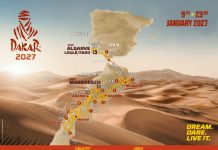
Following the opening of the service park on 5 January in Loulé-Faro, administrative and technical scrutineering will take place there from 6 to 8 January. The sporting action will begin in Portugal on 9 January with the prologue, before the first special stage the following day. The stage will continue with a transfer to the port of embarkation for Nador, Morocco. The Mediterranean crossing will take place overnight.
Upon their arrival on the African continent on 11 January, competitors will make their way by transfer to the first Moroccan bivouac in Bouarfa. From the Oriental region, in north-eastern Morocco, the race will initially head south along the Atlas Mountains, the true backbone of the Kingdom, via Zagora, then Agadir, where the caravan will take a 24-hour break.
It will then be time to turn away from the Atlas and venture deep into the vast, distinctive deserts of the country’s far south. Smara, then almost to Dakhla, will mark the furthest points on the map of the second week. From there, the caravan will begin its journey back north, once again via Smara, before following the Atlantic Ocean and reaching Marrakech, its final destination.
The route, designed over recent weeks based on the knowledge accumulated by the organising teams and a series of reconnaissance missions, meets the usual standards of the season’s biggest rally-raid event, with 4,341 km of special stages, a figure close to the format of recent editions. On a daily basis, most special stages will range between 350 and 500 kilometres. A substantial average, especially in light of the specific nature of the terrain to be covered. Experts know: Morocco’s deserts are among the most demanding in the world, for drivers and co-drivers as well as for their machines.
David Castera, Dakar Director
„The relocated 49th edition of the Dakar will meet the sporting standards that have always made it the most demanding rally-raid event. Despite the short timeframe we have had to work with, we have designed a true Dakar. The ACP (Automóvel Club de Portugal) is supporting us in Portugal, having established its round of the FIA-FIM World Rally-Raid Championship as a cornerstone of the season since 2024. And in Morocco, our expertise across the entire territory, combined with the operational capabilities of our internal teams, allows us to go far beyond the formats previously offered in the country: competitors will discover the Kingdom from one end to the other. We will explore all its distinctive features through a route of unprecedented scale. Here too, the country’s expertise in hosting major international events, as well as the quality of its infrastructure, will be invaluable in enabling us to offer everyone a truly first-class Dakar.
We are already grateful for the loyalty of the competitors who are overwhelmingly choosing to follow us on this new adventure (350 already registered to date). They will also be able to count on the support of the media and our partners, who are reaffirming their commitment alongside us in these exceptional circumstances. As usual, the Dakar will be broadcast in more than 190 countries around the world.
The adventure continues, as do preparations for the historic celebration of the 50th edition in Saudi Arabia.“
ROUTE
Loulé/Faro > Loulé/Faro
09/01/2027 – Prologue
129 km (special stage > 29 km)
The prologue is a short exercise, but it promises to be intense in the Algarve, where it will be marked by a reunion with Portugal, in front of a crowd passionate about motorsport in general and the Dakar in particular. The popular enthusiasm could well extend to fans from all over Europe lining the 29 timed kilometres. The pleasure will be twofold for competitors, since the route between the trees has been designed to give pride of place to riding and driving skills. The hardest part will certainly be keeping a cool head to secure good starting positions for the following day’s stage.
Loulé/Faro > Loulé/Faro
10/01/2027 – Stage 1
300 km (special stage > 100 km)
The first stage is a genuine crossing, both literally and figuratively. A stage in three parts. First, one hundred kilometres of special stage in Portugal, where competitors will have to get into the action quickly, just as they did the day before. Another opportunity for the punchy competitors, followed by a second endurance sequence, that of the transfer to reach the Mediterranean before spending the night aboard a boat for a crossing towards Africa.
Loulé/Faro > Bouarfa
11/01/2027 – Transfer
590 km
The third day marks a first break from the stopwatch. Heading towards north-eastern Morocco for a first bivouac set up at the eastern edge of the country, to reach terrain suited to racing, which will resume the following day. One last moment of calm for competitors, who will quickly have to get used to January’s morning temperatures. A transfer north of the Atlas ranges marked by acclimatisation.
Bouarfa > Bouarfa
12/01/2027 – Stage 2
490 km (special stage > 390 km)
Setting off across the Rekkam plateau, competitors will face a wild territory made up of faintly marked tracks that will be reminiscent of those in Saudi Arabia. Terrain suited to navigation challenges, which will immediately come into play. With 390 km of special stage, it will be a day of adaptation not to be missed in order to gauge the challenge of the following days. Because, with the exception of the final stage, all special-stage distances will now exceed 350 km per day.
Bouarfa > Bouarfa
13/01/2027 – Stage 3
490 km (special stage > 410 km)
The 400 km mark for a special stage is crossed with the second and final loop around Bouarfa. The start takes place on vast plateaus, initially faster than the previous day before becoming more technical and sometimes rougher too. It is the middle of the special stage, marked by refuelling, that will shift the day into this second sequence. Whether sandy or rocky, uphill or downhill, finding the right rhythm, as well as the right track, will not be easy. A little-known area of the Kingdom that could well produce surprises. The first pit stop for cars and trucks will add spice to an already demanding day.
Bouarfa > Zagora
14/01/2027 – Stage 4
750 km (special stage > 490 km)
The longest special stage of the first week comes close to 500 km. The pace will be more consistent and higher, interrupted by the race’s only passage through the dunes of Merzouga. A deliberate choice to continue offering an extraordinary route. A section of camel grass will force those who do not wish to remain stuck for too long at the race’s second pit stop, located at the foot of the Mummy, to preserve their machinery. A natural fortress that owes its name to the horror film of the same name, shot in this natural setting. The total of 750 km to reach the second bivouac in Zagora should not give the rookies cold sweats; its sheer variety is intended to showcase the first week.
Zagora > Zagora
15/01/2027 – Stage 5
540 km (special stage > 365 km)
A crossroads for trading caravans in times gone by, located 52 days‘ walk from Timbuktu, Zagora is also the gateway to Morocco’s largest dune massif. Erg Chegaga, also the wildest, lies at the heart of the special stage, with around fifty kilometres of dune crossings, divided into two sections with a rocky interlude. Sandy tracks take pride of place in the region through which the Drâa flows, whose sediments tend to smooth out tracks. Winding routes suited to navigation, which will be the day’s other key element. A pure desert special stage: tyres will not touch tarmac even once.
Zagora > Agadir
16/01/2027 – Stage 6
760 km (special stage > 365 km)
Some will rub their eyes when they see another 365 km of special stage on Stage 6. A grain of Chegaga sand still stuck under an eyelid? No, the special-stage distance is identical to that of the previous day, and another fifty kilometres of dunes are on the menu. A physically demanding day brings the first week to a close. Because more traditional tracks, for once, also stand in the way on the road to Agadir, where a well-deserved rest is in sight after a total of 760 km. Nothing less than the biggest figure of the opening week.
Agadir
17/01/2027 – Rest day
Agadir > Smara
18/01/2027 – Stage 7
790 km (special stage > 500 km)
What a surprise for the restart! The second week features the longest special stage of the 49th edition: 500 km. A long timed section on fast tracks, with plenty of navigation. This is the second major challenge after Stage 4. The one that will bring the race back onto the Dakar’s historic route, when it headed towards Mauritania. Heading towards the far south, its whitewashed facades and blue doors. An entirely different type of desert lies ahead for the coming days. The Dakar opens a new chapter as it leaves the beaches behind.
Smara > Refuge bivouac
19/01/2027 – Stage 8
525 km (special stage > 355 km)
Competitors leave Smara to be reunited with their assistance crews the following evening. In the meantime, it is time for the formidable marathon-refuge stage: avoiding any mistakes is the absolute rule. Without a support team, competitors must rely on their resourcefulness or the solidarity of their peers to continue their journey. The Dakhla lagoon and its kitesurfing sails will form a distant backdrop to the bivouac, where „khaimas“ (pronounced „ra-y-ma“), traditional tents made from hair woven by nomads, will already have been pitched. To experience a traditional Berber night, competitors will first have to tackle another cocktail of old, very little-used sandy tracks, small dunes and vast plateaus. All the ingredients of Morocco’s far south, unseen since Bouarfa.
Refuge bivouac > Smara
20/01/2027 – Stage 9
625 km (special stage > 390 km)
Returning safely without putting too much strain on the machines to emerge from this interlude of a solo mini transatlantic crossing of the sands is a key moment in the race. This year, it also carries another symbolic significance: it marks the turning point of the second week, with the journey back north beginning here. But Smara is still a long way off, even farther than yesterday! The special-stage distance sits just below the 400 km mark, and dunes will continue to roll like waves on the high seas. The maze of southern tracks still holds surprises for navigators.
Smara > Smara
21/01/2027 – Stage 10
560 km (special stage > 470 km)
The loop special stage around Smara is the third longest of the route. As always, this also means that the pace is higher. Fast plateaus, sand, small dunes: the southern landscapes will vary and unfold one last time. This is also where competitors will encounter the highest proportion of wadis and sandy canyons. One final tour through the endless desert expanses before finding the Atlas Mountains once again as a landmark on the way to the final bivouac in Marrakech.
Smara > Marrakech
22/01/2027 – Stage 11
1,035 km (special stage > 455 km)
The journey north to Marrakech exceeds 1,000 kilometres, making it the longest stage of the race. But before reaching the „Red City“, there is still sand, plenty of it in fact. The first third of the special stage is devoted to almost pure driving, before moving onto more undulating tracks and finally skirting the Atlantic Ocean along a coastal track. The descent onto Plage Blanche for around twenty kilometres flat out on the sand will be the image of the day. Sea spray with a hint of the Red Sea, but competitors must not get carried away too soon. Because a labyrinth of tracks will stretch all the way to the finish of the special stage, with new terrain and surroundings to which they will have to adapt to avoid settling into a false rhythm.
Marrakech > Marrakech
23/01/2027 – Stage 12
240 km (special stage > 22 km)
A historic terminus for trading caravans, the „Red City“ owes its name to its rammed-earth ramparts. One final fortress of 22 km of special stage still separates the Touareg trophies from their contenders. The final special stage could take on the atmosphere of a Marrakech Grand Prix along the route, such is the destination’s worldwide appeal. The Marrakchi spirit of celebration during the prize-giving ceremony will be the highlight of this Moroccan interlude.